 A close-up photograph of a shelf filled with white paper document binders.and boxes full of archival papers. Image provided courtesy of Pixabay.
The Goal
The aim of using A.I. to assist with transcription is to expedite the transcription process and put the information in the proper historical context, while still remaining an accurate and useful tool.
The Process
Part of the appeal of using A.I. to assist in transcription is that the process is fast and simple. That being said, it is also important to prioritize caution and accuracy above all else. The A.I. used for each image transcription will be Gemini Pro, which is widely thought to be on the cutting edge of A.I. Transcription. Each image below can be clicked, and when clicked the user will be taken to a new page where the results of the transcription are displayed. Gemini is simply prompted to “Transcribe” and whatever it responds with is directly copy-pasted below the image on this new page. At the bottom of each page there is an editor’s note correcting any mistakes, or noting if no noticeable mistakes were made. As a sort of ‘stress-test’ of the A.I., the images being transcribed will be taken with a mobile phone camera. Each image is sourced from the UMW Special Collections archive. To see what AI said about a particular image, just click on it, and it will take to its corresponding page.
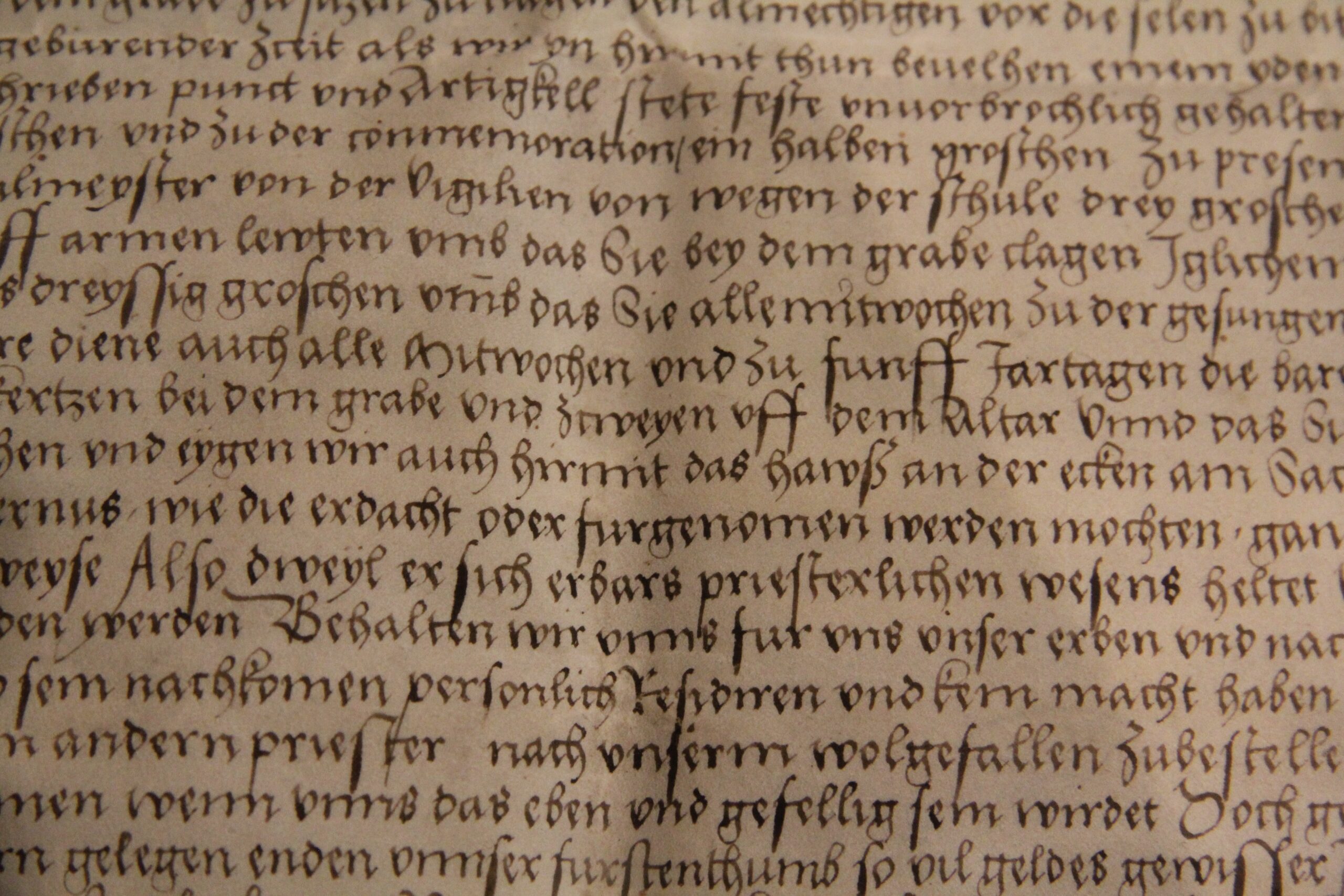 Image of handwritten, old text on yellowing parchment. The language is unclear, but it looks to be medieval or even older. Image provided courtesy of Pixabay.
Results
The AI has shown a remarkable capability to transcribe handwriting, place that handwriting in context, and even understand the geographic locations mentioned in the dataset. A few images, like the ledger images proved to be a bit confusing for the AI, but Gemini Pro was able to handle most of the images with almost perfect accuracy. This could be especially useful in cases where there is a large volume of handwritten text spread out over an archive. The AI is not perfect, but many of its mistakes are also places where a human could reasonably make a similar mistake (for example, the handwritten ledgers with messy handwriting. The AI is also quite good at relating one image to another in context (for example Gemini Pro was able to relate many of the above images to each other geographically), which could be very useful for the history of a certain county or city. The transcription has proven to be accurate, fast, and helpful. This could conceivably be a revolutionary new tool for archivists and educators. This is an especially useful tool in terms of ‘mind-numbing’ data sets like ledgers and logbooks. In all, this aspect of the experiment has proved totally successful.
 This image shows a fountain pen open over top of a piece of paper. The pen and paper look to be on top of an orange surface. Image provided courtesy of Pixabay.